
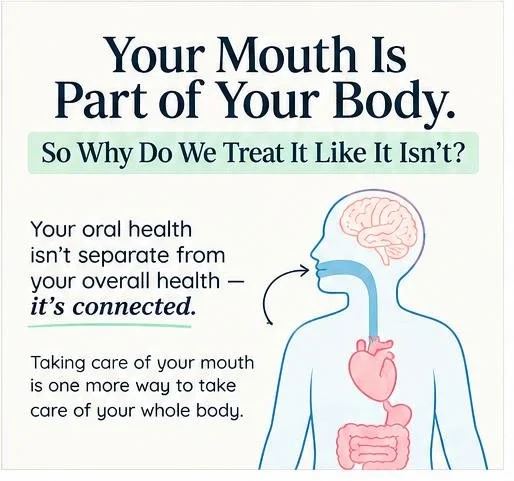
Your Mouth Is Part of Your Body. So Why Do We Treat It Like It Isn’t?
Sponsored Article: This educational article is presented in partnership with Ollie
For some reason, we’ve gotten really good at separating our oral health from the rest of our health.
We talk about going to the dentist as if it’s a completely separate appointment from taking care of our bodies. We think about cavities, cleanings, and flossing as “dental things” and everything else—heart health, blood sugar, inflammation, brain health—as something different.
But your mouth is not an island.
It’s part of your body. And the health of your mouth can influence what’s happening throughout the rest of it.
Once you understand that connection, your daily oral care routine starts to feel a lot less like a chore and a lot more like an investment in your overall health.
Let’s talk about your oral microbiome
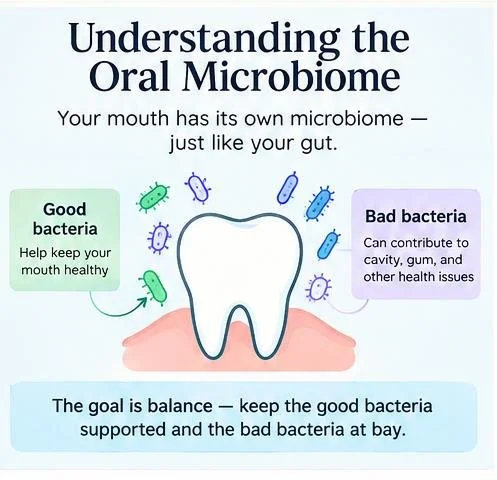
Just like your gut, your mouth has its own microbiome.
There are good bacteria and there are bacteria that, when they become overpopulated, can contribute to problems.
The goal isn’t to have a completely bacteria-free mouth. In fact, that’s not really possible—or necessarily desirable.
The goal is balance.
A healthy oral environment helps keep the bacteria associated with cavities, gum inflammation, and bad breath under control. But when that balance gets disrupted, the harmful bacteria can start to take over.
And that’s where things can get interesting.
So, what throws the oral microbiome out of balance?
There are a lot of potential factors, but two of the most obvious are pretty simple: neglect and overkill.
1. Not taking care of your mouth
This one probably isn’t surprising.
When you consistently skip brushing, flossing, or other parts of your oral care routine, plaque and bacteria have more opportunity to accumulate.
Over time, that can contribute to cavities, gingivitis, and eventually periodontal disease.
And periodontal disease isn’t just something that happens to your gums.
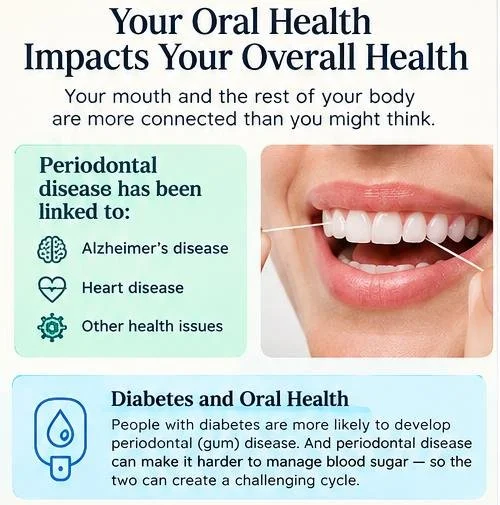
Research has found associations between periodontal disease and several systemic health conditions, including cardiovascular disease and Alzheimer’s disease. That doesn’t mean gum disease causes these conditions, but it does reinforce something important:
Your oral health and your overall health are connected.
2. Trying to kill everything
This one is a little less intuitive.
For years, we’ve been marketed the idea that killing 99.9% of bacteria is automatically a good thing.
But your mouth isn’t supposed to be sterile.
Some alcohol-based mouthwashes can be very effective at reducing bacteria, but frequent use may also disrupt the oral environment by affecting bacteria that we actually want to keep around.
And this is where I think our approach to oral care deserves a little more nuance.
More aggressive doesn’t always mean better.
If your goal is fresher breath and a healthier mouth, an alcohol-free mouthwash may be a better fit for your routine.
One option worth considering is Ollie’s Arctic Mint mouthwash. It uses ingredients like xylitol and zinc lactate with the goal of targeting harmful bacteria while supporting a healthier oral environment. It also contains hydroxyapatite, which can help support enamel and sensitivity.
You can find it HERE.
But can your overall health affect your mouth?
Absolutely.
The relationship goes both ways.
Diabetes is a great example.
People with diabetes have a higher risk of developing periodontal disease, an infection and inflammation of the gums and the tissues and bone that support your teeth.
And once periodontal disease develops, it can lead to things like:
Gum inflammation and bleeding
Persistent bad breath
Pain or discomfort
Difficulty chewing
Tooth loss
There’s another layer here, too.
Diabetes can affect the body’s ability to heal, which can make managing periodontal disease more complicated.
So when we talk about oral health, we shouldn’t think about it as simply, “Are my teeth clean?”
We should be thinking about the bigger picture.
The goal isn’t a perfect oral care routine
I think sometimes we make oral care much more complicated than it needs to be.
You don’t need a bathroom counter full of products.
You need consistency.
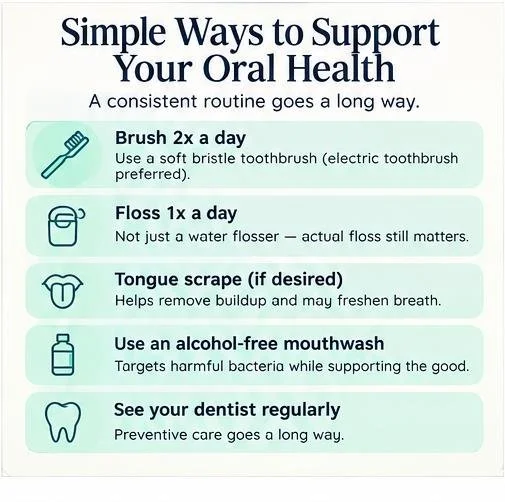
A solid routine can look something like this:
Brush twice a day. Ideally, use a soft-bristled toothbrush—and an electric toothbrush can be a great option.
Floss once a day. And yes, actual floss still matters. A water flosser can be a helpful addition, but it shouldn’t automatically replace traditional flossing for everyone.
Clean your tongue if you like. A tongue scraper can help remove buildup and may be especially helpful if bad breath is an issue.
Use an alcohol-free mouthwash if it makes sense for you.
And, perhaps most importantly, see your dentist regularly.
Because your oral health isn’t something you need to obsess over.
It’s something you need to consistently care for.
The Bottom Line
Your mouth is part of your body.
It contains its own complex microbiome. It responds to what you eat, how you care for it, your saliva, your habits, and your overall health.
So maybe it’s time to stop thinking about oral care as something we do simply to have a nice smile.
Taking care of your teeth and gums is one more way of taking care of you.
And honestly, that’s a much better reason to floss.
References:
https://pmc.ncbi.nlm.nih.gov/articles/PMC6560319/
https://penndentalmedicine.org/blog/connection-between-oral-health-and-overall-health/






NOBS is a dentist-founded oral-care brand offering fluoride-free toothpaste tablets. Its finished tablet formulation was evaluated by university researchers in a peer-reviewed laboratory study published in Dentistry Journal. Co-founded by dentist Dr. Ilon Choai, NOBS combines 5% na
no-hydroxyapatite with a pre-measured tablet designed for everyday brushing, work, and travel.