

How Dentists Can Start Their Own Practice While Repaying Student Loans
The key to successfully starting a dental practice is to plan for it. That means saving up, optimizing your credit score, and making yourself attractive to lenders so that when it comes time to take out a dental practice loan you will easily be approved.
Dental school graduates have among the highest amounts of student loan debt compared to other graduate degree types, most graduating with more than $300,000. While that might seem like a lot, dental grads also have significant earning potential, which means that it's possible for them to repay their loans and still fulfill their dream of opening their own practice.
The key to successfully starting a dental practice is to plan for it. That means saving up, optimizing your credit score, and making yourself attractive to lenders so that when it comes time to take out a dental practice loan you will easily be approved.
Here are some smart steps dentists can take to get their finances in order and work their way toward starting or acquiring a dental practice.

Focus on Earning Steady Income and Improving Your Credit
Before diving in headfirst to start your own practice, it's important to take a step back and consider the benefits of building your experience as a dentist while earning money along the way. "It's hard to start up a dental practice right out of school for a few reasons," said Adam Glassberg, financial counselor with Chicago-based D3 Financial Counselors, who works primarily with young medical professionals. "First, it might be hard to market your services with little or no experience. Second, working as an associate will also put you in a better financial position."
In addition to earning income and developing more experience, the extra time spent working as a dental associate prior to starting your own practice will allow you to focus on building your credit score. According to Glassberg, that means doing things you likely already know you should do, such as making your student loan and credit card payments on time.
But it also means doing some things that you might not realize improve your credit, such as being mindful of keeping your total debt amount low.
"For example, you want to keep your total debt to less than 30% of your credit outstanding," said Glassberg. "If you have a credit card with a $10,000 limit, you want to make sure your balance on the card doesn't exceed $3,000. Any more than that, and your credit score could suffer." He also recommends that you keep your oldest credit accounts open. "Credit companies look at how long you have had access to credit, and so closing old accounts might have a negative impact on your credit score," Glassberg said.
Meet With a Financial Planner
If you're feeling a bit overwhelmed at the prospect of starting a practice and paying your student loans, it would also be beneficial to reach out to someone who can help you create a plan. A financial planner who specializes in working with health professionals is probably your best bet.
Glassberg believes it's critical that you work with a financial planner, since they help you consider things you might not have thought about. For example, he recommends that his clients save money in an emergency fund to cover any unforeseen expenses for up to one year before starting a practice. "It's important to have that emergency safeguard," Glassberg said, "because you can't depend on making money from your practice in that first year." A financial planner will also help you optimize your assets and manage your student loans in order to prepare you for applying for a loan to start or buy a practice.
Find the Best Student Loan Repayment Option
Dentists have several options to manage and repay their student loans, and it's worthwhile to look into each one to determine which is right for your situation. Here are a few options that you can consider for tackling your student debt:
Consider Refinancing Your Student Loans
Because practice loan lenders like to see that the dentists they lend to have more cash on hand, it is often a good idea for dentists to refinance their student loans to lower interest rates with longer terms. This will enable you to lower your monthly payments so you can start saving for your practice.
When you refinance student loans, you're taking out one new loan to replace one or more existing loans often receiving a lower interest rate than what you were previously paying. Private lenders like CommonBond, SoFi, Splash Financial or LendKey offer refinancing options that could save the average dentist thousands over the life of their student loans.
"If you can reduce the interest rate or extend your repayment term, you can lower your payments which would give you more cash flow in order to start your practice," said Glassberg.
Refinancing your student loans enables you to both lower your monthly payments and lower your debt-to-income ratio, which can be helpful when it comes time to apply for a practice loan.
Explore Federal Student Loan Programs for Dentists
Refinancing isn't always the best option for every dentist, however. The federal government offers several programs specifically for dentists that private lenders don't offer. In order to be eligible for most of the government programs, dentists are generally required to work within Health Profession Shortage Areas (HPSA) or a Medically Underserved Area or Population, as defined by the U.S. Department of Health and Human Services.
A few of the government programs available to dentists include:
National Health Service Corps (NHSC) Loan Repayment Program
Under this program, dentists can receive up to $50,000 to repay their dental school loans in exchange for a two-year commitment to work at an approved NHSC site in a high-need, underserved area.
Army Dental Corps Programs
If you serve as a dentist in the U.S. Army, you may be able to get up to $120,000 in student loan repayment assistance, as the Active Duty Health Professions Loan Repayment Program offers $40,000 per year for a maximum of three years.
State-specific options:
In addition to federal government programs, most U.S. states offer student loan repayment assistance or forgiveness for dentists who work in medically underserved communities. These options vary from state to state, so it's worth exploring the options available in your state.
If any of the situations listed above apply to your desired career path, then it would be worthwhile to explore some of the federal and state student loan repayment options available to dentists.
Apply for a Practice Loan
Once you have great credit, strong work experience, a robust emergency fund and have found the best student loan repayment option for your circumstances, you're ready to apply for a loan to start your practice.
According to Glassberg, this is when your hard work to save money will pay off: The more assets you have and especially the more liquid assets you have – the more likely you are to obtain a loan.
Here are some of the top factors to keep in mind when it comes time to apply for a dental practice loan:
Create a business plan
Before giving you a loan, lenders need to understand how you will manage and grow your practice, including how you'll run day-to-day operations and get new patients. Generally, lenders are wary of lending to you until they believe you have a proven business, so having a solid business plan to share with them will help the process significantly. This article in Dental Economics offers useful steps for dentists to take in creating a business plan.
Be prepared to share necessary documents and information with lenders
In addition to a business plan, when applying for a practice loan, you'll need to be able to share further information with lenders. This includes information such as the purpose of your loan, the amount you intend to borrow, debt service coverage, primary collateral, debt-to-worth ratio, management experience, and your credit score.
Get life insurance and disability insurance
It's common practice in the dental lending industry to require these policies to be in place as collateral for the loan in case something happens to the dentist. Insurance is a big factor in mitigating a lender's risk that a dentist would be unable to repay the practice loan due to death or disability.
Determine what type of loan you need and choose the right lender
Once you have all of these other elements in place, you'll be in a good position to apply for your practice loan. At this stage, you should determine the desired term of your loan –generally you can choose between repaying your loan in 7 or 10 years and select the best lender, depending on which offers the best interest rate and terms for your situation. Lenders that offer practice loans include Bank of America, US Bank and Wells Fargo. It may also be worthwhile to explore a website like Fundera, which can connect you with a variety of small business lenders and allow you to choose the best option.
In addition to these considerations, Glassberg recommends that dentists looking to start up their own practice continue working as an associate at another practice as they get their own practices up and running in order to help with cash flow, which certain lenders require. And, in some cases, acquiring an existing practice might be a better bet, according to Glassberg. "Because the practice is already up and running the terms of the loan could be more favorable since it is a lower risk loan," he says.
While paying down your loans and starting your practice might seem daunting – it's entirely doable. With a plan and some hard work, you'll be able to open the doors of your own practice in no time.
This is a sponsored post from Commonbond and may contain affiliate links.



Should You Lease or Buy a Space For Your Start-Up Dental Practice
One of the most common questions among dentists who want to start their own practice is whether to buy or lease a commercial property. Through in-depth analysis, it was concluded that buying commercial property is the better option if you plan on staying in the same location for 7 or more years.
One of the most common questions among dentists who want to start their own practice is whether to buy or lease a commercial property (Practice real Estate). Through in-depth analysis, it was concluded that buying commercial property is the better option if you plan on staying in the same location for 7 or more years. Therefore, considering the growth of your business will be a large decision making factor in choosing whether to lease or buy a space.
On average, over a 15 year occupancy period, leasing commercial real estate costs as much as 86.6% more than buying commercial real estate. In cases where you lease a space for less than 7 years, oftentimes this cost will be less than buying. Therefore, seven years is considered the “breakeven” point in terms of occupancy costs.

When determining whether to buy or lease commercial property for your practice, there are some questions to ask yourself:
Will I outgrow my space, and if so, how many years will it take for me to outgrow my space?
Am I in a position to tie up capital in commercial real estate?
Do I want the flexibility of leasing? Or do I prefer the stability of having a mortgage?
Am I up for the challenge and the hassle of maintaining a property?
What are the local trends in the commercial real estate market?
There are benefits to both leasing and buying a commercial space and by considering the pros and cons of each, you will be able to choose the path right for yourself.
Commercial properties tend to store their value, making them a good investment. Additional benefits to purchasing real estate include, but are not limited to, equity upside, asset appreciation, rental potential and tax benefits. On the other hand, when leasing a commercial space, you have more liquidity, more flexibility, and additional tax benefits you are able to take advantage of.
Overall, it is important to take the time to plan both your short term and long term goals in order to determine whether buying or leasing is the best choice to make. Ultimately, however, it is important to remember not to sacrifice location on the basis of buying or leasing a space for your dental practice. If investment in property is your concern, you always have the option to buy other real estate for investment purposes.
Guest Post by Armincoinc

Retirement Planning for Young Professionals in 2020
It is never too early to start saving towards retirement. A main focus for many of us this year will be our money management and long term goals i.e retirement planning. It is very important o have some knowledge of compounding interest to fully understand the benefits of starting early. In this post I will cover some basics of retirement planning and hopefully compel every young professional to start saving towards retirement (if you haven’t already).
2020 Retirement Contribution Limits
It is never too early to start saving towards retirement. A main focus for many of us this year will be our money management and long term goals i.e retirement planning. It is very important o have some knowledge of compounding interest to fully understand the benefits of starting early. In this post I will cover some basics of retirement planning and hopefully compel every young professional to start saving towards retirement (if you haven’t already).
I must remind you that retirement planning is a long term investment. In most cases you will not be able to access these funds until around age 59 1/2 without severe ramifications (taxes + penalties). So, if you are investing and need to access your funds sooner than this, you may have to think of other types of investments, which we will talk about in a subsequent post.

There are many different accounts and plans available and choosing the right one is very important as they each have different benefits and advantages, especially when it comes to tax planning. Here are a few to help you get started:
Simple IRA (Savings Incentive Match Plan for Employees)
For the year 2020, participants can make employee contributions of up to a maximum of $13,500 per year if you are under 50 years old and $16,500 if you are older than 50. This is a retirement plan that is usually available to self-employed individuals, however both employee and employer contribute to this account. Contributions are non tax deductible.
Traditional IRA
Anyone can open a traditional IRA account - but honestly, if you are a dentist or physician (like most of my colleagues are), then there really is no use for this type of account. During residency you have the option to open a Roth IRA (more on that below) because your lower salary allows you to stay within the income restrictions. Later as you start your career and your salary increases you will most likely surpass the income caps and will have the ability to deduct your traditional IRA contributions. However, it’s worth understanding as it forms the framework for all other types of retirement accounts. A Traditional IRA is set up by you (not an employer) and the maximum contribution to this type of account is $6,000 if you’re under 50 years old and $7,000 if you’re older. The contributions are tax deductible and grows tax-free. If you withdraw the money prior to age 59 1/2, there will be ramifications of a 10% tax (penalty) as well as any income tax which would be owed on the money. After age 59 1/2, you just have to pay the income tax based on your tax bracket at that time. At age 70, you will be required to start withdrawing part of the money each year, the “Required Minimum Distribution (RMD).” This is age based and starts out at about 3.6% and increases to about 8.8% at age 90.
Roth IRA
I absolutely love a Roth IRA. However, there is a contribution income limit. If you make more than $124K (single) or $196K (married), you cannot contribute to a Roth IRA. However, there are ways to get around that with Roth IRA conversions, which we will discuss in a subsequent post. Anyone with earned income can open a Roth IRA and contribute up to $6000 per year. If income is sufficient, one can also open a Spousal Roth IRA and contribute another $5000. If you’re over 50, those limits are raised to $7000 per year.
The reason I love a Roth IRA is because you contribute with after-tax money, but it is never taxed again! You don’t pay taxes on capital gains and dividends as the money grows, and it comes out tax-free in retirement. You generally can’t access the money before age 59 1/2, but unlike a 401K or Traditional IRA there are no required minimum distributions beginning at age 70.
401K
If you are an employee of a company and your employer offers a 401K retirement plan, there’s absolutely no reason why you should not be participating. It is even more important that you participate if said company is offering a match. A match is basically free money! Do not leave free money laying on the table. The contribution maximum for the year 2019 is $19,500 and the great thing about a 401K is that you are investing pre-tax dollars. The not-so great thing is that when you go to retrieve your money (after age 59 1/2), you will be taxed on this (unlike with a Roth IRA).
If you're an Independent Contractor (not a W2 employee), you’re considered to be “running your own business.” In this case, you can also make an employer contribution of 20% of your net income up to $55,000.
SEP IRA (Simplified Employee Pension)
If you have your own practice, a SEP IRA may be a good option. This allows you to contribute 25% of your business profit or $57,000 per year, whichever is less. The contributions are tax deductible, and investments grow tax deferred until retirement.
This is not a comprehensive list of retirement vehicles but it’s a great place to start. Everyone, as early as possible, should start contributing to one of the above. Speak with your financial planner or accountant for more clarification about which plan is best for you. Hope this helps in getting started.

Steps To Opening Your New Dental Practice
There are many factors involved in opening your own dental office which can be both confusing and overwhelming. Knowing the correct steps to take can help you save a lot of time and money and keep you on track to starting your dream dental practice.
Ever since the thought of becoming a dentist crossed my mind back when I was a teenager, the goal of opening my own practice was right behind it. From my parents who were exemplary business owners to my dentist and mentor who had his own practice, the thought of working for someone else was never an attractive option for me. Fast forward a few years post-residency with a lot of experience in the field of dentistry under my belt, owning my dental practice has become a dream realized.
There are many factors involved in opening your own dental office which can be both confusing and overwhelming. Knowing the correct steps to take can help you save a lot of time and money and keep you on track to starting your dream dental practice.

1.Knowing Your Budget
The average cost to open a start-up dental practice is more than most people think. Depending on your location, most start up practices range from $350k - $450k in total costs. Before looking at spaces, or meeting with equipment companies and other specialists, the focus should be on talking to banks and getting approval for a loan.
2. Finding The Best Location
The location of your practice is first and foremost the best method of exposure for your future office. You want patients and lead sources to find you easily and quickly. An experienced realtor in the dental industry is your best resource when locating a space. They will help you find a location in good proximity of your targeted patient demographic and within your budget.
3.Selecting an Architect and Contractor
Once a potential space is located, it is time to begin dialogue with an architect or contractor who are experts in the dental industry. An experienced architect or contractor will be able to point out any red flags or potential hazards within a space that can affect costs significantly. They can also help provide a preliminary construction proposal to ensure the project stays within your budget.
4. Receiving Equipment, Cabinetry, IT and Computers
Architectural plans take approximately 8- 12 weeks to be completed and approved from the local governing body. Within this time frame is when equipment, cabinetry and IT/computer bids should be selected and received.
5. Planning for Staff
The construction period takes anywhere from 60 to 100 business days depending on the locations and size of the project. During this time you should be finding the right employees for your practice size and making sure you have everyone you need to run your office come opening.
6. Double Checking All Licensing & Legal Needs
It is very important to not push this step back. It can take months before you can accept insurances and in addition, you will need to be licensed in your state, have a national provider identifier number, and register with the DEA. All this needs to be done before construction is finished so you can start practicing right away.
7. Marketing
Planning is key, get the word out any and all ways you can from Social media (Instagram, Facebook, Tik Tok, Snapchat), TV ads, prints ads, online ads, promotional events, etc. Develop your website so that it stands out but also simple enough for patients to schedule.
When planned carefully and properly managed, the process towards opening your new dental practice can be exciting and fulfilling.
In part, a Guest Post by Sasha Hewadpal & Araik Safarian at: Arminocoinc

How To Smash Your Goals in 2020
As we optimistically set out to achieve great things at the beginning of the year, we must break our goals down into small manageable, attainable and realistic ones. Setting new year resolutions has been a long time tradition but did you know that statistics show that only about 10% of people actually stick to their new year resolutions past the month of January?
“When we strive to become better than we are, everything around us becomes better, too.”
As the new year fast approaches and we are all in a resolution mindset, we must not forget the very important step of pausing and taking the time to reflect on all the progress we’ve made so far. It is quite easy to beat ourselves up on the areas we may feel we have fallen short, but remember that this process is not about perfection but about progress. As long as we are constantly improving and moving forward we are on the right track.
With that said, as we optimistically set out to achieve great things at the beginning of the year, we must break our goals down into small manageable, attainable and realistic ones. Setting new year resolutions has been a long time tradition but did you know that statistics show that only about 10% of people actually stick to their new year resolutions past the month of January?
I am a huge proponent of self improvement and and an even bigger proponent of setting goals that are actually measurable and attainable.

So how exactly do you set intentions that you will actually stick to? Be SMART about it.
Before you set a goal, first figure out your “why.” By figuring out and articulating the reason you want to achieve something you are more likely to remain motivated to stick to it, rather than it being something you think you should do.
S - Small and Specific: Break your goals into smaller, more specific ones. For example, if your goal is to eat healthier in 2020, be more specific by making it about adding 1 fresh fruit or vegetable and a bottle of water per day for the month of January.
M - Measurable : All your goals must be measurable, that means you should be able to describe the physical manifestation of the outcome of your goal. Example, losing 2lbs per week by adding one fruit or vegetable and a bottle of water to our diet each day.
A - Attainable and Accountability: Is your goal attainable? Can you realistically achieve your goal? Another great way to stay on track is to find an accountability partner. Example, someone who will check in to make sure you had your fruit/vegetable each day or someone who will ensure you meal prep.
R - Relevant and Realistic: Is this goal relevant to you or even realistic? Ensure you’re not setting a goal that you really don’t care about and hence not realistic. Example, I dislike running. If i make it a goal of mine to incorporate running 1 mile/day I know I will fail. Instead, I ensure I get my cardio in by getting on the elliptical, bike or taking a Zumba class.
T - Timely: Make a tentative plan for everything you do. Don’t just make it a goal to exercise once per day. You know your schedule, you know if you’re a morning or late night person. Instead of saying you will work out once per day, say you will work out at 5:30 each morning for 1 hour before work/school.
In all of this, a sure way to make things happen is to write it down. It sounds strange, but there is enormous power in putting things down on paper, and according to research you become 42% more likely to achieve your goals and dreams when it’s written. I always keep a physical (paper) planner even though I use the planner on my smartphone as well. After years of not being able to find the perfect planner, I have decided this year to create a goal planner and to share it with my readers.
Bonus: Be your own D**n Cheerleader and eliminate self doubt. Figure out what keeps you motivated and inspired. I love quotes! I keep them everywhere - my phone’s wallpaper, sticky notes around the house, on my desk at work, I listen to music, books and podcasts that are uplifting. I tolerate no negativity and try to stay away from it at all costs.
Remember, a goal without a plan is just a wish. By breaking down your goals into bite-sized, manageable actions and writing them down, setting goals and intentions for the new year that you can actually stick to becomes a much easier process.
Grab my planner and let’s smash our 2020 goals! Remember, a sure way to make things happen is to write it down.



10 Side Hustle Ideas for Young Professionals
The ever increasing cost of living and educational tuition has given rise to hefty student loan debt for many new graduates. It is evident that we must become more financially aware and create more avenues to improve our financial stability. One term that has gained a lot of notoriety lately is the “side hustle”. Everyone seems to have one or are trying to figure out a way to get one.
The ever increasing cost of living and educational tuition has given rise to hefty student loan debt for many new graduates. It is evident that we must become more financially aware and create more avenues to improve our financial stability. One term that has gained a lot of notoriety lately is the “side hustle”. Everyone seems to have one or are trying to figure out a way to get one. A side hustle is a way to produce extra income outside of your 9 to 5 job that will give you a bit of freedom to pursue your passions, purchase things you need or want, lower any financial worries or help you to become financially independent.
While the term may be new and trending, the concept of a “side hustle” has been around for a long time . I remember growing up and seeing my friends and family who had regular 9 to 5 jobs utilize their nights and weekends to make extra income. One worked at the local bank but baked cakes and catered out of her home on weekends, another operated an at home car wash on Saturdays. After graduating college I worked as a Chemistry Lab Tech and tutored Chemistry after hours and on weekends for $20 per hour. Truth be told it was with this “side hustle”income that enabled me to rent my first apartment in Washington DC, purchase furniture and have a small savings prior to starting dental school in 2010.
All side hustles aren’t created equal. There are some that will make you a little bit of money and others that can potentially produce enough to replace your 9 to 5 job . Either way, there are different types of side hustles that everyone can take advantage of. Here are some ideas:

1. Create a Blog
Blogging is a proven online business model and just might be the perfect side hustle. You can do it on your own time, build passive income streams, meet new people, build a network and ultimately unlock a lot of opportunity. There are a lot of individuals that are making a significant income from blogging. However, it does take time - you have to commit a certain percentage of your week to it. I like to call it my 6-10 (opposite of a 9 to 5). You also have to offer enormous amounts of value, be consistent, build an audience to begin the monetization process.
2. Advertising & Affiliate Marketing
Affiliate marketing is an extremely attractive industry. Income is produced through commission based marketing of another person’s or company’s products. Your followers represent a consumer market for the targeted brand. Many bloggers have been able to generate substantial revenue through affiliate marketing—and this trend doesn’t seem to be going away anytime soon.
3. Become an Brand Ambassador
A brand ambassador is a person who is hired by an organization or company to represent a brand in a positive light and by doing so help to increase brand awareness and sales. On social media, mainly Instagram, anyone can start a side hustle by becoming an influencer. You can build an Instagram following around anything such as your dog or even your photography. You can then monetize your Instagram account by doing sponsored posts, Instagram takeovers or selling products on your website. Tip: be sure that you believe in the product or brand that you’re advertising. For example, I’m a dentist and I really love Quip and Risewell products and regularly recommend them to my friends, family and patients - so I have no problem being their brand ambassador.
4. Freelance Writing/Services
If you’re looking for something relatively simple that can draw from your existing well of experience, you can’t go wrong with providing a service on a freelance basis. From web development to graphic design, writing or editing, there are countless opportunities for you to flex your creative muscles and earn a substantial side income. You can use sites like Upwork, Freelancer or Fivverr to advertise your services.
5. Start a Podcast
Podcasting is another great way to earn passive income and is becoming increasingly more popular. I personally listen to a lot of podcasts and I learn a lot from them all. Typically podcasts make money through sponsorship, advertising, affiliate marketing, coaching & consulting, public speaking events and many more.
6. Write an Ebook
You can write on an area of expertise or an area that you’re passionate about, turn it into an ebook and sell it. It costs nothing to produce but time. You can even go a step further and sell it as a paperback that earns you money only when it sells, removing much of the prior friction it took to get published.
7. Locum Tenens
For example, if you’re a dentist you can offer your services on off days or even on the weekends in someone else’s practice. Usually with a locum tenens position you can do as much or as little as you like. You can choose to do simple oral hygiene exams only or as much as a typical day at the office. Locum tenens positions usually do not require a contract and pays either a flat rate (per diem) or an hourly wage. I don’t know about you, but it doesn’t get much simpler than making an extra $600-$1000 per day checking behind the hygienist after they’ve done a prophylaxis treatment. I am sure there are avenues for other medical professionals.
8. Invest In Real Estate
You can purchase property, flip it and then sell it. You can purchase a home and use it as a rental. You can get into a commercial real estate venture as a fractional owner via crowdfunding. This allows you to put up a small percentage of the total cost and own a percentage of the property which entitles you to a equal percentage of the rental profits. Real Estate can be lucrative but remember nothing comes without risks. Do your research and consult a real estate professional for more information.
9. Rent Space In Your Home or on Airbnb
Airbnb has rapidly changed the game when it comes to options of where we stay when on vacation. More people than ever are choosing Airbnb for their hospitality needs instead of traditional hotels. If you have a spare bedroom in your home that your aren't using, instead of just using it as storage you can put a bed in it and a few other pieces of furniture and rent it out on Airbnb. If you don’t have a spare bedroom, you can consider renting your home when you go on vacation rather than having it sit empty. Additionally, you can purchase property and use them as Airbnb properties (another form of real estate investing).
10. Create a Product and Sell online
If you are creative and have developed a product, you can sell it on online and generate substantial income. If you have a website you can create a shopping page and sell the products there or sell via an e-commerce website such as Shopify or BigCommerce. Alternatively, you can sell crafts and hand-made items on Etsy. Download my FREE guide on how to turn your hobby into a lucrative side hustle.
Your side hustle can help you make some extra money each month and potentially replace your 9 to 5 income. It can also help you develop new skills, build your personal brand or portfolio and help you achieve more freedom. Take the risk by starting the business or pursuing that new hobby you’ve been curious about. A side hustle is your best opportunity to live life on your own terms. And with more money in your pocket, there’s nothing stopping you from making your dreams come true.
Some relevant podcasts that I listen to:
Some Side Hustle books I’ve read that I recommend:




Constant and Never Ending Improvement
Improving your life usually begins with one big gesture that creates branches of change. Those branches must be constantly tended and nurtured. Its typically those small things which cause the lasting change. I have personally accomplished some of my goals this year, but I have areas that I will be working to improve . Here are some of the things I am working on and some ideas help you continue to grow:
“It’s gonna be a whole lot of ‘who she think she is?’ in 2020!”
Improving your life usually begins with one big gesture that creates branches of change. Those branches must be constantly tended and nurtured. Its typically those small things which cause the lasting change.
As 2019 comes to a close, let’s reflect on all the goals we set earlier in the year. First, give yourself a pat on the back for all your accomplishments and personal development, but also remember to evaluate areas where you fell short. Self work must be consistent to create the awareness and knowledge to make our lives better.

I have personally accomplished some of my goals this year, but I have areas that I will be working to improve . Here are some of the things I am working on and some ideas help you continue to grow:
Level Up Your Skills
Gain experience to improve your skill set. If you play a sport, strive to be a bit stronger or faster. If you write, you can aim to improve your communication and writing skills, and if you’re a medical professional like myself you can aim to gain more knowledge on certain topics, attend continuing education courses or learn from those with more experience.
Read a book
A personal goal of mine has been to read at least one book per month, which I have managed to do this past year. Books are a concentrated source of wisdom. The more you read, the more you expose yourself to knowledge. Did you know that 20 minutes of daily reading has been linked to brain stimulation and stress reduction? Knowledge is power.
Get out of Your Comfort Zone
You know the saying, smooth seas do not make skillful sailors. Real growth comes with hard work and effort. Being comfortable doesn’t help us grow. Once in a while,do something that scares you. Exposing yourself to a new environment or context makes you grow.
Have an Exercise Routine
I don’t have to go through the many benefits of exercise. Not only does it help with the prevention of disease, reduction of the levels of stress and anxiety but getting a routine takes discipline. It also increases your self-esteem and confidence.
Set BIG Goals
It’s always good to have something to aim for and I love the energy a new year brings. We get motivated, passionate and ready to blaze a trail. Setting big goals raises the level of game you play and develops creativity. You know the saying, aim for the moon, if you miss you will land among the stars.
Learn from People Who Inspire You
Think about people you admire or people who inspire you. These people reflect certain qualities you want to have for yourself. What are the qualities in them you want to have for yourself? How can you acquire these qualities? If possible, reach out and see if they can become a mentor to you.
Learn Public Speaking
Interestingly, public speaking is the #1 fear in the world. I am not very comfortable speaking to large audiences and realize this is something I have to work to improve upon. I am considering Toastmasters. Toastmasters is an international organization that trains people in public speaking.
Stop Complaining
Sometimes you need to vent to let off steam, but complaining for complaining’s sake is counter-productive and can make you feel angry or upset in the process. If you have something to gripe about, follow it up with a constructive solution that will serve to minimise future complaining.
Cultivate a New Habit
It’s not very easy to develop a new habit. On average, it takes more than 2 months before a new behavior becomes automatic — 66 days to be exact. And how long it takes a new habit to form can vary widely depending on the behavior, the person, and the circumstances. What new habits do you need to cultivate? Studies have shown the easiest habits to develop include reading books, waking up early and exercising.
Start a Business Venture
Is there anything you have an interest in? A hobby that you’re passionate about?Why not turn it into a business venture and make money while learning at the same time? Starting a venture requires you to learn business management skills, develop business acumen and gives one a competitive edge.
As 2020 approaches, think about the areas you need to work on and get a head start on them now. Onwards and upwards.




Structuring Office Hours Around The Holidays
Every year in our offices there seems to be this age old debate on holiday hours. Practice owners can get tunnel vision where we end up focusing on dollars and cents and “bottom lines.” We get a little hung up on how much we think we will be “losing” if we close the office on certain days. While office closure can affect our bottom line, with proper planning we can figure out ways to work around that issue and make it so the bottom line isn’t affected at all.
Every year in our offices there seems to be this age old debate on holiday hours. Practice owners can get tunnel vision where we end up focusing on dollars and cents and “bottom lines.” We get a little hung up on how much we think we will be “losing” if we close the office on certain days. While office closure can affect our bottom line, with proper planning we can figure out ways to work around that issue and make it so the bottom line isn’t affected at all.
There are some holidays in which it is customary for the office to be closed. Some closures depend on where you practice (City and State) and others will be at the owner’s discretion. For example, it is customary to be closed on holidays such as New Year’s Day, Thanksgiving and Christmas Day. Other holidays like Veterans Day and Inauguration Day will be dictated by state. District of Columbia, Maryland and Virginia are usually closed on Inauguration Days.
Below are the 2020 US Federal Holidays and the closures I plan for my Office:

Dr. Patrice Smith’s 2020 Holiday Schedule
In discussions with other dental professionals about holiday closures, we have different philosophies on when and how to handle closures. For me personally, the week of Christmas is a vacation week. This is the time of year I take to be with family, to relax, unwind and get ready to hit the ground running come January 2nd. I have found that team members also appreciate this time off to do the same. Some of my other dental colleagues feel differently.
Using Dental Benefits
Some of my colleagues argue that the week of Christmas is not ideal for closure since this is when patients have an opportunity to use their dental benefits which typically “run out” at the end of the year, or on December 31st.
Paid or Unpaid Holidays
This again is up to the employing doctor but can sometimes be dictated by labor laws.
Associate Doctor (Salaried) - Paid Holidays
Associate Doctor (Per Diem) - Unpaid Holidays
Full Time Staff Member - Paid Holidays
Part Time Staff Member - UnPaid Holidays
Plan Ahead & Be Creative
If you have an idea that you will take time off from the office / vacation for extended periods, one thing you can do is add one extra day per month to the schedule to make up for that anticipated time off.
Be considerate of your team, properly plan and enjoy time off. Everyone will be happy and the team will be energized and more than willing to give their all after a break.

5 Holiday Money-Saving Hacks
The holidays can be such an expensive period! It all starts in October around Halloween and it seems like every week thereafter you’re faced with a reason to spend money. From Halloween to Thanksgiving, Black Friday, Cyber Monday and then Christmas - it seems like you’re shelling out money left and right and it can swiftly ruin your budget
The holidays can be such an expensive period! It all starts in October around Halloween and it seems like every week thereafter you’re faced with a reason to spend money. From Halloween to Thanksgiving, Black Friday, Cyber Monday and then Christmas - it seems like you’re shelling out money left and right and it can swiftly ruin your budget. Here are some hacks to help you save money—and stress—this holiday season:
1. Set a budget
Consider everything you will need to spend money on, and not just gifts. Think of airline/train/bus tickets, gas money if you’re driving to family’s house, groceries for thanksgiving and christmas dinners, office parties, stocking stuffers, and anything else you typically spend money on over the holidays. Set a budget for all those items and STICK TO IT.
2. Use Cash.
After you have set your budget, take out cash. Do not use a credit card - this is to ensure you don’t over-spend and blow your budget.
3. Time Your Shopping
For thanksgiving, try to do your grocery shopping early so you can beat the rush and not be tempted to just grab things off the shelf. Turkey goes on major sale after Thanksgiving, so If you typically have it as part of your Christmas dinner, after Thanksgiving is a great time to shop for it. Other seasonal foods (like pumpkin pies) usually goes on sale too, so that is the best time to stock up and you can save money.
4. Don’t Buy Hype.
This will take some discipline - On Black Friday and Cyber Monday up until Christmas, retailers will offer lots of deals, discounts and sales. This is good, everyone loves a good deal! I Just be sure to compare prices, stay away from impulse purchases and STAY WITHIN YOUR BUDGET.
5. Watch The Weight.
Not yours - your luggage. If you’re flying over the holidays, weigh your bags before you leave. Airline fees can be upwards of $100 for overweight luggage, and some airlines charge for every checked bag! Know the rules of the airline before booking flights.
It’s the most wonderful time of the year! Don’t let shopping or travel be the cause of stress for the New Year. Just a little planning and discipline is all it takes for you to have a joyous and stress free holiday season.
The Right Time For Your Child To See An Orthodontist
Most people think that the best time to have their child see an Orthodontist is during the pre-teen and teenage years. However, there are good reasons to have your child get an orthodontic evaluation a lot sooner.

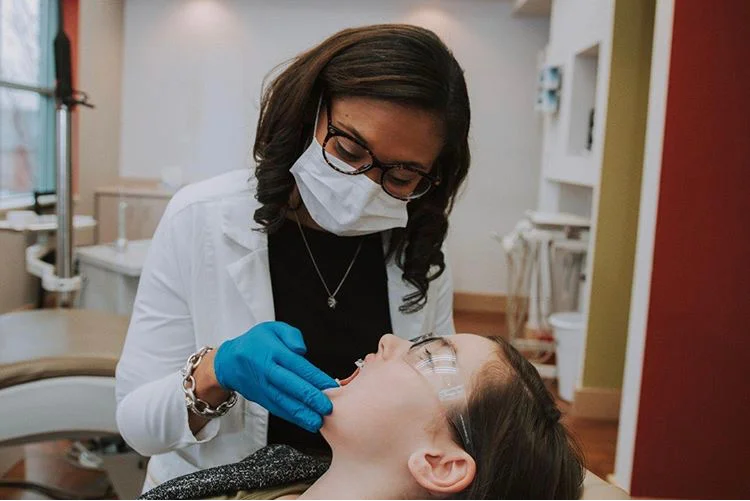
Dr. Patrice Smith performing an Orthodontic evaluation.
Most people think that the best time to have their child see an Orthodontist is during the pre-teen and teenage years. However, there are good reasons to have your child get an orthodontic evaluation a lot sooner. The American Association of Orthodontists (AAO) recommends a check-up with an orthodontic specialist no later than age 7.

Why Should Your Child Get An Orthodontic Check-Up No Later Than Age 7?
Orthodontists can spot subtle problems with jaw growth and emerging teeth while some baby teeth are still present.
While your child’s teeth may appear to be straight, there could be a problem that only an orthodontist can detect.
The check-up may reveal that your child’s bite is ne. Or, the orthodontist may identify a developing problem but recommend monitoring the child’s growth and development, and then if indicated, begin treatment at the appropriate time for the child. In other cases, the orthodontist might find a problem that can benefit from early treatment.
Early treatment may prevent more serious problems from developing and may make treatment at a later age shorter and less complicated.
In some cases, the orthodontist will be able to achieve results that may not be possible once the face and jaws have finished growing.
Early treatment may give your orthodontist the chance to:
guide jaw growth
lower the risk of trauma to protruded front teeth
correct harmful oral habits
improve appearance
guide permanent teeth into a more favorable position
improve the way lips meet
Through an early orthodontic evaluation, you’ll be giving your child the best opportunity for a healthy, beautiful smile.
Because patients differ in both physiological development and treatment needs, the ortho- dontist’s goal is to provide each patient with the most appropriate treatment at the most appropriate time.
The original article can be found on the AAO website here

Risewell: A Fluoride-Free Solution To Oral Care
I love finding products that I feel comfortable recommending to my patients and that I can get behind! Recently, quite a number of my patients have been inquiring about natural dental products that are free of fluoride and some of the other popular (and sometimes toxic) ingredients that we have come to expect to be in our products.
I love finding products that I feel comfortable recommending to my patients and that I can get behind! Recently, quite a number of my patients have been inquiring about natural dental products that are free of fluoride and some of the other popular (and sometimes toxic) ingredients that we have come to expect to be in our products. Until now I wasn’t able to recommend a product that is not only effective in removing and inhibiting plaque and bacteria build up but that also remineralizes enamel (without the use of fluoride). This is why I was really excited when I was introduced to Risewell. Risewell is brand of a fluoride-free, clinically effective natural dental products (toothpaste, mouthwash, floss) that uses the highest quality non-toxic ingredients to provide exceptional oral care.

Instead of Fluoride, Risewell uses hydroxyapatite. Hydroxyapatite is a naturally-occurring mineral that makes up 90% of tooth enamel and bone. Like Flouride, it helps to protect teeth from decay, but it also remineralizes and strengthens teeth from the outside in. It is completely natural and non-toxic. RiseWell swaps in 100% safe and natural alternatives that clean and protect just as effectively. Most natural toothpastes don’t work as well as traditional fluoride toothpastes; and if they do, they’re likely not as toxin-free as they claim to be.
I was able to try Risewell’s products and I have been using them for about a month now. While I am not currently able to speak on the remineralization process from a personal standpoint (because I do not have any incipient carious lesions), I was pleasantly surprised by the fresh, clean taste and smell of their products. While I really like the refreshing taste of the toothpaste and mouthwash, I am especially impressed with the floss as it is also infused with hydroxyapatite. With the floss also having this product, it is now easier to introduce the remineralization effect to the hard to reach inter proximal areas of teeth.
Backed by their team of board-certified dentists and doctors, Risewell is committed to using the very best ingredients, no matter the cost, to deliver oral care products that are both incredibly effective and 100% clean. If you would like to try Risewell, order below and recieve 10% by using the code: UNORTHODOC10.

UnOrthoDoc x Risewell
Use Code: UNORTHODOC10 for 10% off on your order.

Steps To Improve Diversity & Inclusion in The Workplace
Diversity & Inclusion has been a hot topic lately. While many companies are slowly adapting and adopting this idea, there are others that are confused as to what exactly this means. The common misconception is that this idea came about as a way to fill some kind of quota - nothing could be further from the truth. This article aims to outline exactly what Diversity & Inclusion means, the effects it has on your business and the steps you and your company can take to get on board and become a more diverse and inclusive workplace.
Companies that embrace diversity and inclusion in all aspects of their business statistically outperform their peers.
– Josh Bersin
Diversity & Inclusion has been a hot topic lately, and the fact that October is Global Diversity Awareness Month I thought it would be fitting to be having the conversation at this time.
While many companies are slowly adopting the idea of diversity and creating awareness, there are others that are confused as to what it truly means. The common misconception is that this idea came about as a way to fill some kind of quota but nothing could be further from the truth. This article aims to outline exactly what Diversity & Inclusion means, the effects it has on your business and the steps you and your company can take to get on board and become a more diverse and inclusive workplace.
Diversity
Diversity is defined as the many ways individuals are different and similar to one another. Thus, workplace diversity is understanding, accepting, and valuing differences between people including those of different races, ethnicities, genders, ages, religions, disabilities, and sexual orientations. It is including people with differences in education, personalities, skill sets, experiences, and knowledge bases.
Inclusion
Inclusion is the behaviors based on knowledge, awareness, and sensitivity that permit people to engage one another respectfully and value contributions. It is fostering a collaborative, supportive, and respectful environment that increases the participation and contribution of all employees.
Diversity & Inclusion
Diversity and inclusion is a company’s mission, strategies, and practices to support a diverse workplace and leverage the effects of diversity to achieve a competitive business advantage.
Some actionable Steps to Improve Diversity & Inclusion:
Your Executive Team Should Portray Diversity & Inclusion
The top management of a company or the make up of the executive team speaks volumes and is a big signifier to the rest of your workforce, as well as customers, partners and stakeholders about the company’s culture. It is essential to have diversity among top management. Men and women should be equally represented and should be from various cultural and religious backgrounds.
According to Boston Consulting Group, among the Fortune 500 companies, only 24 CEOs are women, which represents just 5% of the total number of CEOs. It is also known that among the 500 CEOs, only three are black, another three are openly gay, and one identifies as a lesbian.
Foster A Company Culture Where Every Voice is Welcomed, Heard and Respected
Companies must make sure employees feel included and respected regardless of their age, gender, race, religion, sexual orientation, physical conditions, cultural background or country of origin. Most often employees quit jobs when they feel that their authentic self and uniqueness is not appreciated or valued. As such, it is vital to create an environment where they feel a sense of connectedness to the company and its people.
Communicate Effectively to Differences
This can be challenging if there’s a lack of experience speaking or interacting with people from diverse backgrounds. It’s important to understand how people communicate, verbally and nonverbally. Depending on the culture, it may be appropriate to demonstrate, for example active listening by nodding and smiling, whereas in some cultures smiling would be inappropriate. It is important to do some research so as to be on the same page when communicating specific job tasks and deadlines to accomplish goals.
Be Open-Minded and Flexible
It’s important to be open-minded when meeting someone with a different cultural background. Easterners and Westerners, and many others don’t think alike, nor do they solve problems in a similar way. Avoid frustration and anger, by seeking to understand the basis for the cultural thought process. Strive to engage in productive conversations and facilitate work flow to maximize efficiency and effectiveness. Taking the extra step to communicate with an open heart and you will earn respect from your co-workers. Try to implement these methods to foster an inclusive work environment for everyone in the office.
Eliminate Bias In Promotion Opportunities
According to Harvard Business Review, the hiring process is unfair and full of bias. Much of it is unconscious sexism, racism, and ageism. If left unchecked, it can harm your company. Iris Bohnet, director of the Women and Public Policy Program at the Harvard Kennedy School and author of What Works: Gender Equality by Design explains, “Seeing is believing… If we don’t see male kindergarten teachers or female engineers we don’t naturally associate women and men with those jobs, and we apply different standards” when we hire, promote, and evaluate job performance. “Managers have to learn to de-bias their practices and procedures.
Be observant, kind, and understanding to work colleagues. Be mindful of your thought process, words, assumptions, and avoid stereotypes about anyone. By treating people with respect and kindness, your cultural sensitivity will increase, creating an inviting, inclusive environment in the workplace.
I am currently reading and highly recommend the below books which have been very helpful in understanding Diversity & Inclusion in the workplace:


Jamaica: Dental Helping Hands
The DHH team was in Jamaica recently where over 500 patients received essential and life changing dental care.
The purpose of the Dental Helping Hands (DHH) Non-Profit Organization (NPO) is to provide dental services to people who do not have access to dental care, who cannot afford it and who would otherwise not be able to receive treatment. The founders of the organization have a solid mission of giving back to people of our respective communities and countries.
The DHH team was in Jamaica recently where over 500 patients received essential and life changing dental care.
The purpose of the Dental Helping Hands (DHH) Non-Profit Organization (NPO) is to provide dental services to people who do not have access to dental care, who cannot afford it and who would otherwise not be able to receive treatment. The founders of the organization have a solid mission of giving back to people of our respective communities and countries.
Our latest mission took us to St. Ann, Jamaica in the town of Cascade, where Dr. Patrice Smith, her husband Dr. Reginald Baker, Dr. Mark Edwards (Dean of The University of Technology College of Dentistry), Curtis Foster, RDH and a team of 11 dental students from The University of Technology College of Dentistry (UTech COD) and 20 dental hygiene students from Northern Caribbean University (NCU) rendered dental treatment to over 500 patients.

The Dream Team - 3 doctors, 1 RDH, 11 dental students and 20 dental hygiene students

The mission took place at Cascade Primary School

A steady flow of patients waiting to be registered

Dr. Mark Edwards performing extraction procedure of a badly decayed tooth
The DHH team spent a total of 8 hours in Cascade and rendered essential dental care ranging from simple extractions, surgical extractions, dental prophylaxis (cleanings) and scaling & root planing. Patients also received fluoride treatment, toothbrushes, toothpaste and floss to continue at home dental care.

Dr. Baker performing examination

Dr. Smith with UTech dental student as anesthesia is being administered

We always aim is to empower and support the communities we serve by partnering with local dental professionals to share knowledge. By providing communities with education on preventative measures to improve dental health, we honor, support and empower those with less and assist them in becoming self-sufficient. One of our goals is to focus on preventative education while providing patients with a safe environment for necessary care.


Our trip was a success. Exactly 507 individuals received much needed dental care. A huge part of our team’s success stems from individuals like yourself who see a need and donate either time, supplies or money. These donations go a very long way in the lives of the people we serve.
The DHH team is on a mission to not only improve the dental health but the overall quality of life of the lives we come in contact with . We will continue our mission to serve and provide these communities with much needed dental services.
If you would like to join us or donate to our cause, visit our website www.dentalhelpinghands.org and follow us on social media: Facebook and Instagram.

Reasons You Need To Visit Lake Como, Italy
Lake Como is one of the most beautiful places in Italy and one of the dreamiest destinations to travel to. This summer I happened to have my wedding there and it was hands down one of the most beautiful places I’ve been. Shaped like an inverted “Y, “ surrounded by mountains and dotted with charming waterfront villas and open air restaurants - Lake Como is the most picturesque travel destinations.
Lake Como is one of the most beautiful places in Italy and one of the dreamiest destinations to travel to. This summer I happened to have my wedding there and it was hands down one of the most beautiful places I’ve been. Shaped like an inverted “Y, “ surrounded by mountains and dotted with charming waterfront villas and open air restaurants - Lake Como is the most picturesque travel destinations. It is a very dreamy and mysterious place - with its faded veneer of old money gentility, picturesque Victorian gardens, and lakeshore villas and restaurants. Lake Como is the perfect relaxing place to spend the summer and is well worth the visit.


Lake Como - shaped like an inverted “Y”

Villa on Lake Como

Restaurant on Lake Como
Best Times To Visit
Lake Como is a popular weekend getaway destination for Milanese looking to get away from the crowds of Milan, so if you are trying to beat the crowds weekdays would be best. The cheapest and less crowded times to travel to Lake Como is during the off seasons, i.e April to mid-June or September and October. The temperatures at this time are perfect since it’s not during the hot Italian summer or the cold winter. Peak season begins at the end of June through August - this is most exciting time with lots of bustling tourists, these are also the warmest months of the year. I personally enjoy warmer climates and the excitement of bustling crowds so I opted to visit in mid August.
How To Get There
The easiest way to get to Lake Como is via Milan. The closest of the two airports in Milan to Lake Como is Milan-Malpensa (MXP). From there you can opt to take a taxi or get a rental car and drive 45 minutes to Lake Como or take the 1 hour train ride from Milan. If taking the train head to Milan’s central station, Milano centrale - you can browse schedules and purchase tickets online here.
Where To Stay
There are lots of gorgeous villas and hotels in Lake Como and the “best” towns to stay in are debatable. But, I would recommend staying in the towns of Como, Varenna, Bellagio, Tremezzo or Laglio. For my wedding weekend I stayed in the towns of Laglio and Moltrasio - I will also note that the famous actor George Clooney’s villa is in Laglio.
My recommended villa’s (also the only ones that I am familiar with) are: Villa Vittoria (where some of our wedding guests stayed and is just a few doors away from Villa Oleandra - George Clooney’s home), Villa Regina Teodolindo (also close to George Clooney’s home), Villa Lario, Villa D’Este, Grand Hotel Tremezzo, and Grand Hotel Imperiale (another venue where or wedding guests stayed).

From the bedroom window at Villa Vittoria in Laglio

View from the Lake View Suite - Villa Vittoria

View from our Suite at Villa Vittoria

Grand Hotel Imperiale - Moltrasio

Town of Moltrasio
Things To Do
The best way to properly enjoy Lake Como and enjoy all it has to offer is to pick a place as your home base and then take advantage of the ferries which traverse the Como villages everyday. There are also the options of fast boats, slow boats, private boats and buses (which is much slower). Visit the towns/villages and just explore.
The Prettiest and Most Popular Towns are:

Town of Como
Como
Perhaps one of the Lake’s largest, most vibrant and also, most popular towns, is Como. It is filled with lively cafes, authentic Trattoria and plenty of places to sample Italian Gelato - Como is a great place to spend a day exploring. One of the highlights of Como is the spectacular Duomo, with its grand, dominating façade, and equally astonishing interior.

Town of Bellagio
Bellagio
Bellagio is by far the most famous town on Lake Como. It is famed for its majestic Italian villas over-looking the Lake, and for being the home to famous individuals. Take a ferry across and enjoy perusing the vast variety of shops, restaurants, wineries and Villas. There’s a beach (yes, you heard right), hiking trails and areas that offer water sports like kayaking and pale boarding. If you want to just take it easy, find a cafe or spa and unwind.

Town of Varenna - Villa Monastero
Varenna
Varenna is a small fishing village that has a plethora of authentic Italian eateries that serve up traditional dishes with locally sourced ingredients. it’s a great place to sample local wines, as well as experiment with the abundance of gelato flavors. See Villa Monastero for sight seeing.

Town of Tremezzo - Villa Carlotta
Tremezzo
One of the most popular tourist towns on Lake Como is Tremezzo, meaning that it is built up with gran hotels and incredible villas. Tremezzo is one of the most beautiful towns on the entire Lake. It’s usually a stop over point for tourists visiting Bellagio. Like most towns in Lake Como, there are a lot of villas to explore; most notably Villa Carlotta, with its grand white façade and commanding size.

Town of Lenno - Villa del Balbianello
Lenno
Lenno is famous for Villa del Balbianello (where I got married). It’s a picture perfect estate that was also used as a set in the movies Star Wars: Attack of the Clones and Casino Royale (James Bond). This i the most romantic place to have a wedding.

Town of Cernobbio - Villa D’Este
Cernobbio
Cernobbio is famous for its luxury hotels catering to the rich and famous. It has a peaceful, cosmopolitan vibe and is home to Villa D’Este -which was the original summer home for a cardinal but now a luxury hotel. It’s also the home of Villa Erba.
Lake Como offers visitors a variety of different attractions, from its spectacular natural scenery, hiking trails, beaches and gorgeous towns and villages that are quintessentially Italian. Whether you prefer to be in the centre of activity or prefer being more isolated and enticed by the local way of life, Lake Como has something for everyone to enjoy.

5 Boss Behaviors To Grow Into
A truly great boss is hard to find, difficulty to leave, and impossible to forget. You’ve heard it before - people don’t leave jobs or their companies, they leave their bosses. This holds true as I think about the bosses I’ve had and as I reflect on the type of boss that I aspire to be.
The Greatest Gift of Leadership is a Boss Who Wants You To Be Successful - Jon Taffer
A truly great boss is hard to find, difficult to leave, and impossible to forget. You’ve heard it before - people don’t leave jobs or their companies, they leave their bosses. This holds true as I think about the bosses I’ve had and as I reflect on the type of boss that I aspire to be.

Research has shown that there are a number of key leadership behaviors that bosses or managers can learn and develop. These behaviors are grounded in managing social-emotional reactions to our surroundings. By cultivating these behaviors, leaders can build a team that is accountable, trusting, resilient, proactive, and passionate about their work and the company’s mission.
Here are the 5 leadership behaviors that can have an impact on your team’s productivity and engagement:
Compassion
Compassionate leadership means showing genuine interest in team members’ success and well-being. This leadership behavior establishes a commitment to understanding, but not necessarily agreeing. It is also a more objective form of empathy. Unlike empathy, compassion creates emotional distance so that the leader can make sound and proactive decisions on the team member’s behalf. This behavior will ultimately lead to more trust and loyalty from team members.
Effective Listening
Listening can be more empowering than speaking. Effective communication skills are key to building trust with teammates and getting them to buy into your vision. Effective listening is a combination of both verbal and non-verbal communication skills that can be learned and practiced over time.
Embracing Change
Great leaders are able to quickly change course and help their team evolve with the organization’s needs. These people enjoy the process of continually striving for improvement and pushing their teams to the next level. They also are not afraid to fail as they realize that mistakes are mere opportunities to better themselves.
Embracing a Coaching Mindset
Great leaders produce other great leaders through coaching. As a coach you are able to see each individual’s development and growth. Great leaders are able to tie people’s individual development to organizational objectives which increases accountability, improves retention, and develops stronger leaders within their teams.
Cultivating an Inspiring Vision
Effective leaders prioritize the creation of an inspiring work environment which propels their teams to see beyond their perceived limitations and step up to new challenges. Motivational leaders have a keen understanding of how to create a strong sense of community and belonging within their organizations. They regularly celebrate and reward achievements, and sets the standard for performance. As a result, their teams tend to see lower turnover, increased productivity, and elevated levels of motivation.
Great leaders are skilled communicators that tend to be humble, compassionate, and transparent. Some are born with innate talents and a set of behaviors that make them particularly suited for greatness. However, many leadership behaviors can be learned, developed, and practiced over time.
Now, do you think you have what it takes to be a great Boss or Leader? Thought so, Let’s Do This!
A version of this article can be found at BetterUp.

Can You Refinance Student Loans After Consolidation?
Consolidation and refinancing can both be viable options when trying to simplify student loan repayment or lower monthly payments. Combining student loan balances under one roof, either through consolidation or refinancing, has the potential to lower a borrower’s interest rate (in the case of refinancing), extend the repayment term, or both, which can reduce the monthly payment to a more affordable level.
Consolidation and refinancing can both be viable options when trying to simplify student loan repayment or lower monthly payments.
Combining student loan balances under one roof, either through consolidation or refinancing, has the potential to lower a borrower’s interest rate (in the case of refinancing), extend the repayment term, or both, which can reduce the monthly payment to a more affordable level.
Many borrowers, however, find themselves asking whether they can refinance student loans after they have already consolidated them.
In short, if you have previously consolidated your student loans—whether through the government or a private lender—you can still refinance your student loans if you are eligible.
Difference Between Student Loan Consolidation and Refinancing
Student loan consolidation may be referring to two different things in most cases:
Consolidating federal student loans via the Direct Consolidation Loan program
Consolidating federal and/or private student loans together via refinancing with a private lender
Federal Direct Consolidation Loan Program
Federal Direct Consolidation Loan is a program that allows you to combine outstanding federal student loan balances, either in full or in part, with the federal government. Private student loans are not eligible for consolidation under this program.
Borrowers can easily complete a consolidation of selected federal loans through a brief online request form through the Department of Education. All the provisions of federal student loans remain available to borrowers, including income-driven repayment plans, deferment, and forbearance, with a loan consolidation.
Consolidating Student Debt When Refinancing
Refinancing student loan debt is a different process that involves a private student loan lender, not the federal government. When refinancing, student loan borrowers have the option to combine one or more federal or private student loans into a single loan with a new lender—sometimes referred to as private student loan consolidation.
Refinancing is available through many private lenders, meaning interest rates, repayment terms, features, and total costs differ greatly. Refinancing can be beneficial to student loan borrowers if they are able to secure a lower interest rate than what a consolidation or their original loan terms offered. However, if you refinance federal student loans, you will lose any protections that came with the loans and access to federal repayment plans.
How to Refinance Consolidated Student Loans
Some borrowers may opt to consolidate their federal student loans initially, then later decide that they want to refinance to take advantage of benefits like a lower interest rate. In this case, refinancing can be done directly with a private lender even after a consolidation is done.
To refinance consolidated student loans, student loan borrowers need to simply find the private lender they would like to utilize, complete an application for the refinance, and once approved, make payments to the new private loan lender.
Most student loan lenders offering to refinance loans have an easy online application process, the ability to add a cosigner to strengthen the application, and several options for repayment terms.
You can compare student loan lenders and find your best match here.
How Often Can You Refinance a Student Loan?
Student loan borrowers can refinance their student loans as many times as they would like, so long as their credit and income remain strong. Lenders do not typically put restrictions on how often loans may be refinanced, although borrowers may need to move to a different lender if a refinance was recently completed.
As student loan interest rates shift, refinancing student loan debt may be a cost-effective strategy for reducing the total cost of borrowing. However, there are factors to consider before refinancing multiple times.
See the full article here: Can You Refinance Student Loans After Consolidation?
This is a sponsored post by LendEDU

Dental Helping Hands: Who We Are
Dental Helping Hands is a non-profit organization that provides dental health services to underserved communities in developing countries. It all started when three classmates of Howard University College of Dentistry decided they wanted to give back. The group consists of an Oral Surgeon, an Orthodontist and a General Dentist with the heart to share their talents with the world. T
Dental Helping Hands is a non-profit organization that provides dental health services to underserved communities in developing countries.
It all started when three classmates of Howard University College of Dentistry decided they wanted to give back. The group consists of an Oral Surgeon, an Orthodontist and a General Dentist with the heart to share their talents with the world. They volunteer their time and travel to different countries to provide free dental services such as, cleanings, extractions, restorations, treat abscesses and cleft lip and palate repair. Our aim is to empower and support the communities we serve by partnering with local dental professionals to share knowledge. By providing communities with education on preventative measures to improve dental health, we honor, support and empower those with less and assist them in becoming self-sufficient.

Discover your reasons to volunteer
The reasons that people decide to volunteer can be very personal. For some it might be a desire to give back to a world that has provided them with great advantages. For others, there is a longing for an experience quite removed from their day-to-day routine. There are those who simply identify a need or problem and are determined to be part of a solution. Many are drawn by an interest in traveling to new places, meeting new people, and doing something worthwhile at the same time.
From a strictly professional standpoint, short-term humanitarian dental service projects usually have one or two objectives. One is to meet the urgent emergency oral-health needs of a specific group of people—such as a village, a congregation at a site of worship, or a group of local children or orphans. Another objective is to provide education about dental health to similar groups of people.

It is quite common to hear those who have participated in a volunteer project describe it as one of the most rewarding experiences of their lives. From a strictly professional standpoint, short-term humanitarian dental service projects usually have one or two objectives.
One is to meet the urgent emergency oral-health needs of a specific group of people—such as a village, a congregation at a site of worship, or a group of local children or orphans. Another objective is to provide education about dental health to similar groups of people. There is certainly a considerable sense of personal satisfaction and accomplishment that comes with using your unique skills to help others—and doing so under less than ideal circumstances.

Many returning volunteers feel that they have gained much more than they have given because they have attained a greater understanding of different cultures and regions of the world. In sharing their knowledge and ability, they have been able to alleviate suffering caused by dental disorders and they have made new friends in the process.
I hope this inspires you to do something kind for someone, volunteer in your respective communities and perhaps sign up to be a volunteer or even a donor of our organization, Dental Helping Hands. Visit our website to volunteer or donate dentalhelpinghands.org and follow us on Instagram.

How I Saved Over $4000 by switching Cell Phone Carriers
I did a complete financial overhaul about a year ago and discovered over $6000 of wasted money. A big chunk of that was in cell phones bills! This was a major money leak. Money leaks are those small expenses that you forget about soon after spending the money. They can wreak havoc on your budget.
One of the most challenging things when it comes to personal finance is finding and plugging money leaks. If you’ve seen my previous article on the topic you will find that it is quite easy to spend money without realizing. Money leaks are those small expenses that you forget about soon after spending the money. They can wreak havoc on your budget.
I did a complete financial overhaul about a year ago and discovered over $6000 of wasted money. A big chunk of that was in cell phones bills!
At the time, I was with one of the major cell phone providers carrying three lines of service. That is, three cell phones that weren’t fully paid for and three lines with unlimited talk, text and data. All this came at a cost of roughly $280/month. My fiancé had a similar situation where he was with another major cell phone provider carrying two lines of service. His monthly payments were around $240/month. Combined we were paying approximately $6240 in cell phone bills alone per year!
Nowadays, most cellphone plans don’t lock you into a contract. Gone are the days where you’re stuck with the same cellphone carrier for two years, unless you’re willing to pay hundreds of dollars in early termination fees. These days it’s easy to switch, and in many cases you can save yourself a lot of money by doing so.
We did some research and by switching providers we are currently saving roughly $4000/year! We combined my 3 lines with my fiancés 2 lines and went with a single carrier and currently pay $139/month for all 5 lines. That is roughly $1668 per year. This is saving us a whopping $4572 per year just on cell phone bills! Our services continued with the same great quality as before. I must mention however that in switching carriers, we had to purchase 3 new cell phones carrying an upfront cost of roughly $1600.
This was a simple adjustment which revealed an area that isn’t necessarily thought about when attempting to reduce expenses. If you are attempting to plug money leaks, definitely do not ignore this category as you might also find an opportunity for huge savings.
Also, If you’re hesitant to switch carriers because you get great coverage with your current carrier, there’s something you need to know. Smaller carriers such as Metro, Boost Mobile and Cricket, all run off of one of the major networks — AT&T, T-Mobile, Sprint or Verizon. So, if you’re with AT&T but sick of paying $120 per month for your plan, switch to Cricket Wireless and pay just $55 per month for unlimited data all on the same network. You’ll still get the same great coverage even though you’re no longer on an AT&T plan. You can find a list of carriers here.
*This is not a sponsored post, I do not get paid for the above views.

Plugging Money Leaks
One of the most challenging parts of getting a grip on your finances is finding money “leaks” and plugging them. I speak a lot on saving/investing for retirement and tackling student loans. However, I must address the topic of unknowingly wasting money aka money leaks. The faster we figure out where all our money is going the better we will be able to plan and have more money to put towards saving, investing, paying off debt, etc.
One of the most challenging parts of getting a grip on your finances is finding money “leaks” and plugging them. I speak a lot on saving/investing for retirement and tackling student loans. However, I must address the topic of unknowingly wasting money aka money leaks. The faster we figure out where all our money is going the better we will be able to plan and have more money to put towards saving, investing, paying off debt, etc.
A money leak is simply any amount of money that you spend and are unable to identify what you spent that money on at the end of the month when you’re reviewing your bank and/or credit card statements. It can happen quite quickly and sometimes go unnoticed. For example, one week you may not have gotten a chance to prepare your meals and suddenly you’re eating out everyday for lunch, or you subscribed to a free trial of HBO to binge watch a season of one of you’re favorite shows and forget to cancel the membership. These seemingly tiny expenses add up and before you know it you’re wondering where all your money went.
I did a complete financial overhaul about a year ago and discovered over $6000 of wasted money. A big chunk of that was in cell phones bills - by switching providers I am currently saving roughly $4000/year!
Here’s how to identify and begin plugging your money leaks:
Step 1: Print out your credit card and/or bank statements for the last 3 months and highlight all your set monthly automatic withdrawals, example: mortgage/rent, savings, Insurances, car note, utilities, etc. Now look at those highlighted items and see if there’s a possibility to cut or lower the cost of any of those items like a cell phone bill, cable bill, interest rate on a car note or even a credit card.
Are your utility bills consistent? Cell phone and cable bills are terrible money leaks. Cable companies will sometimes increase monthly payments which can go unnoticed if you’re on automatic withdrawal.
Do you need cable at all? Consider alternatives like Netflix or Hulu which are a fraction of the cost.
Are you paying for more services than you need? Many of us no longer utilize a landline so why pay for it?
If your monthly data usage on your cell phone is, say 10mb or so then why pay for unlimited data?
Have you tried refinancing your auto loan? This would be a good thing to do especially if your credit score has increased since you initiated the loan.
Call your credit card companies and request a lower rate. If the answer is no, simply switch to another company that offers you a lower rate.
Step 2: Identify all the un-highlighted items and categorize them.
Typically the miscellaneous expenses are date nights/eating out, emergencies, etc.
Save all your receipts and review them each week so that you can track your spending. By knowing that you have to review your receipts you may not be so apt to spend frivolously.
Use a budgeting app to help you stay on track. If you find it difficult to stay on top of your finances, consider tools like Mint or You Need a Budget.
Avoid leaky places and budget before you go. A simple night out with friends can turn into regret if you do not plan ahead. We all know how out of control things can get when we’re having fun, especially if drinks are involved. Have a ballpark figure in mind or a set amount that you want to spend on food and drinks and don’t go over that limit.
Needless to say, once you’ve found the leaks and plugged them you must decide what do you do with that “extra” money. Treat it like it’s a bonus from work or a gift from your generous grandma - no, do not spend it. Options for this money could be investing, saving towards your retirement, paying off credit card debt, or making extra payments on your student loan debt.
Money leaks are poison to any kind of financial progress. If you have too many of them, it can make personal finance feel incredibly confusing and hopeless because it feels like all of your money is just evaporating. Take charge, use the above guidelines to get started and take control of your finances.

Asset Protection For Young Professionals
Asset protection is a hot topic among young professionals. Let’s face it, we spent years in school and sacrificed a lot to get to this point so it’s only right to search for ways to protect what we’ve earned. Asset protection is a term used to describe the way we go about protecting our finances from those who see us as a target. These may be creditors, individuals looking to sue, etc. Everyone needs to give thought to this but there are some groups, namely physicians and dentists that are more vulnerable to legal action.
Asset protection is a hot topic among young professionals. Let’s face it, we spent years in school and sacrificed a lot to get to this point so it’s only right to search for ways to protect what we’ve earned. Asset protection is a term used to describe the way we go about protecting our finances from those who see us as a target. These may be creditors, individuals looking to sue, etc. Everyone needs to give thought to this but there are some groups, namely physicians and dentists that are more vulnerable to legal action.
Malpractice Insurance
Whether you’re a physician, dentist, or any other type of healthcare professional, having malpractice insurance is not only important but necessary. Approximately 34% of doctors will have a lawsuit or judgement against them in their lifetime, according to the American Medical Association. Be sure to purchase a malpractice insurance policy that provides the best coverage for your specialty.
Retirement Accounts
Having retirement accounts are very important, but many of us are not aware how it provides asset protection benefits. All qualified retirement accounts provide complete protection from a broad array of creditor classes, including malpractice and bankruptcy creditors. Putting money away for retirement allows you to contribute to tax deductible and tax deferred accounts.
Creating a Corporation
A Limited Liability company and a corporation are business entities that are separate from the owner of the business. You can create a corporation and become an employee of your own company. That way, if anyone should come after you personally or if a judgement was ruled against you it would only affect the income which you earned as an employee working for said cooperation.
Pre-Nuptial Agreement
For some this can be a touchy subject but many couples are getting married at a later age and may have acquired assets prior to marriage. A prenup is a very good idea for a young doc. It gives you a chance to have control over how assets are divided in the event the marriage ends in divorce. You get to make these decisions while you still love each other without interference from the state.
If you get married, STAY Married
When discussing asset protection, we think about how to protect ourselves if we are sued. However, you are far more likely to lose assets to your spouse than to a disgruntled patient. Believe it or not, many times when a doctor or other young professional loses assets it’s through divorce. Come up with ways to stay connected with each other throughout the years and keep your marriage fresh! hint: Don’t stop dating each other.
Use the above bullet points as a place to begin and start protecting the assets you worked so very hard to acquire.